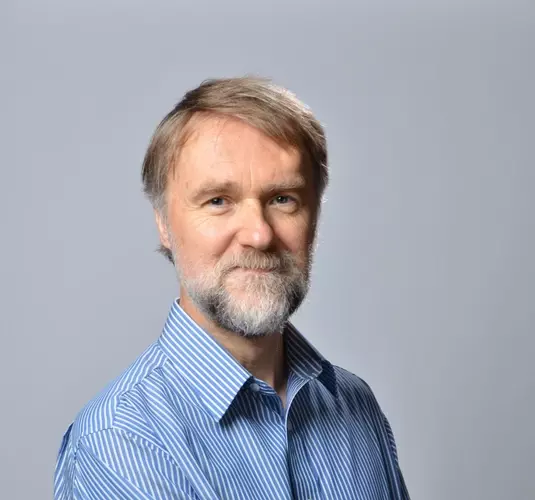
Professor Lawrence J. Hall
Lawrence was born in Perivale in 1955 to Kenneth and Patricia Hall and attended Bishopshalt from 1967 to 1974. He received his B.A. from Oxford in 1977 and his Ph.D. with a thesis on Decoupling and Grand Unification from Harvard in 1981. He was a Miller Fellow at the University of California Berkeley from 1981-83, and a Junior faculty member at Harvard from 1983-86, after which he returned to be a Senior on the U.C. Berkeley faculty, where he has been ever since.
He received Sloan and Presidential Young Investigator Awards, and is a Fellow of the American Physical Society. His research interests have revolved around the fundamental laws of nature and how they are determined. His starting point was the standard model of particle physics, which he viewed as having many more avenues to explore. He describes his work as follows on the U.C. Berkeley website:-
“Could certain aspects of particles and their interactions be better understood in terms of a new symmetry? How are these new symmetries, and indeed many of the symmetries of the standard model, to be broken? The symmetry of the electroweak interaction would imply that there is no difference between the left-handed neutrino and the left-handed electron! These particles differ only because the symmetry is broken -- and yet we do not know how this symmetry breaking occurs. The difference between the masses of the electron and the muon are a sign that flavour symmetries are broken; but again, the origin is unknow
“It is remarkable that we can address such problems, and in the coming decade we shall find answers to at least some of the fundamental questions of symmetry breaking. In recent years he has constructed and studied theories with enhanced spacetime, gauge and flavour symmetries: supersymmetry, and compact extra spatial dimensions with size from sub-mm to inverse TeV to inverse Planck mass. I have worked on grand unified theories in four and higher dimensions, and have considered a variety of frameworks for neutrino masses.
“Recently I have focused on the TeV scale, since it is the range of the Large Hadron Collider. Whether the electroweak symmetry turns out to be broken by supersymmetric interactions, a new strong force, or by extra spatial dimensions, the elucidation of the TeV scale will be as exciting as any previous discoveries in particle physics.
“The cosmos contains both dark energy and dark matter, dominating the contents of a critical universe. These contents of the universe, as well as the asymmetric baryons and background photons, arise from the underlying theory of particle and gravitational interactions.
“For all its successes, the standard model of particle physics does not allow the computation of the density of any of these components of the universe. What theory will? Symmetries have carried us far, but will they take us further? Recently I have explored the extent to which the questions that face us might be answered by environmental selection from a large landscape of vacua.”
(from the physics.berkeley,edu website)